
'Silent Hill f' Explained: In-game Shinto (and Buddhism and Folklore) for Beginners (Part III)
Even more interesting things from the game...

So this is becoming a thing, eh? Here’s Part I and Part II to get you started.
I suppose at this point, I should quickly explain my credentials, as it were. I’m Asha and I’m a religious studies academic with a focus on Japan. I started with anime back in 2000 and began to inhale Japanese culture as I went. I read, I studied, I tried to understand and I’m still learning new things even today!
I have an undergraduate degree in Religious Studies and my most recent Master of Arts degree (with I was awarded With Merit) is in Interdisiciplinary Japanese Studies. For that, I studied Japanee culture in media, such as writing about cultural heritage and Ghost of Tsushima, as well as doing my dissertation on the recent filmography of Shinkai Makoto, and his use of what I term ‘Shinkai Shinto’, a sub-niche of Anime Shinto, to explain the trauma of natural disasters like 3.11.
You can check out that on my ResearchGate, along with my Masters of Art dissertation for my Classics degree, looking at Greek Myth and Magical Girls, by clicking here.
I’m not a Shinto expert but I do specialise in what I term Media Shinto. These are when aspects of Shinto are taken into media and rewritten to suit that media, so Anime Shinto often has a supernatural element (like Kannagi: Crazy Shrine Maidens, in which the spirit of a sacred tree becomes a magical girl). For Shinkai and also Ghibli Shinto, there are spiritual elements and sometimes actual kami, who appear where the worlds of the mundane and the divine meet.
Game Shinto, especially in horror games, tends to take elements of the set-dressing of Shinto and often involves kegare, impurity. and violent rituals where women are sacrificed as part of the plot (see Project Zero, as well as Silent Hill f). However, these games also use Shinto, Buddhist and other elements as a part of the narrative, for example, by having hokora as save points, featuring bosses who are supernatural in scope and also exploring lost and forgotten shrines and temples as part of the wider narrative.
I’ve been travelling to Japan and visiting Shinto Shrines and Buddhist temples for almost a decade. I collect goshuin (shrine and temple stamps) and I’ve been to some interesting rituals, from a naming ceremony/baby blessing to an early morning service deep inside Kamigamo Jinja, one of the most important shrines in Kyoto.
So, now that’s sorted, shall we talk about some more of the interesting Shinto elements found in the game? If you have questions, suggestions or just want to chat about Japanese horror games and their lore, click below!
Yōkai (妖怪)

Yōkai are mysterious creatures from Japanese folklore, they include anything from spirits and Foxes to merfolk, others are closer to goblins and spiritwith animal or elemental connections like kappa and tengu.
Within the game, outside of Foxes, there are no actual yōkai except for those mentioned in the puzzles and art. However they still play a role, both within the game and also within the Japanese folklore that Hinako would’ve been familiar with.
The Nihon Shōki and the Kōjiki
Shinto is an interesting religious tradition in that it doesn’t have a scripture at the heart of its narrative. There are no Ten Commandments, no saviour figure, no eschatology. But there are prayers and rituals, like tthe Ōharae no Kotoba and the Norito. There’s so such thing as a Shinto Bible or anything a Western follower of a monotheistic faith would understand.
But there is the Nihon Shōki and the Kōjiki (which you can read in English translations). These are what would are best described as ancient historical texts which tell the story of the Japanese people, going right back to Izanagi and Izanami, the creator deities, and then weaving real history into mythology, from the descent of the first Emperor Jimmu to more recent events. All of them bound in magic, myth and legend.
Jichinsai (地鎮祭)
This is, simply put, a ground-breaking ceremony held for new buildings however, a version of the ceremony can also be used at the start of productions for film and TV, both to mark the start but also to purify the stages or area.
Within the game, it’s a flyer from Sennensugi Shrine that explains the concept, then narrows it y focusing on wells (which connects to the natural disasters experienced in the area and the resulting Water Dragon Faith),
Regarldess this kind of ritual is a common and important one as it formally announces the start of some big new project or event, ensuring humans and kami are aware of what’a going on.
Onmyōdo (陰陽道)
Earlier I mentioned an omnyōji (陰陽師), but this is someting else we need to talk about as Kotoyuki, in his form as Fox Mask, is seving dual roles as both Hinako’s intended husband and also a priest, with bonus magical knowledge from either his possession by a Fox, or his bloodline (depending on the ending).
If an omnyōji is a practitioner of ‘magic’, then omnyōdo is the term for this ‘way’ itself. However, when discussing Japanese media, most of the time omnyōji have literal magic powers activated by the right incantations and rituals (Looking at. you, Abe no Seimei!) Howeever the real historical form of Onmyōdo was more about bureaucracy and a knowledge of astrology, geomancy and the like, rather than the literal kind of magic see in other fiction,
Fox Mask, despite wearing formal wedding kimono himself, has a background as a priest at Tsuneki Jingu (Tsuneki is also a nice little anagram for ‘kitsune’, or fox, in this case Fox referring to the mystical creature as opposed to the normal kind…) But within the Dark Shrine he also demonstrates Actual Magic™.
There are several points in-game where he uses specific gestures, often called mudras, and incantations (most notable after the Sakuko fight) in which he invokes the Kyukyu Nyo Ritsuryō to banish demons.
Ritsuryō (律令) is basically a universal code used to ensure harmony, which has its basis in a real world criminal code used in ancient Japan. However within the supernatural, it becomes a way to control spirits and banish demons (in a similar way Christians invoke Jesus to do so…) However, when Kotoyuki does it, because the game is set in a world where Actual Magic™ exists the effects are notable and immediate.
Sacred Items and Shinto Altars
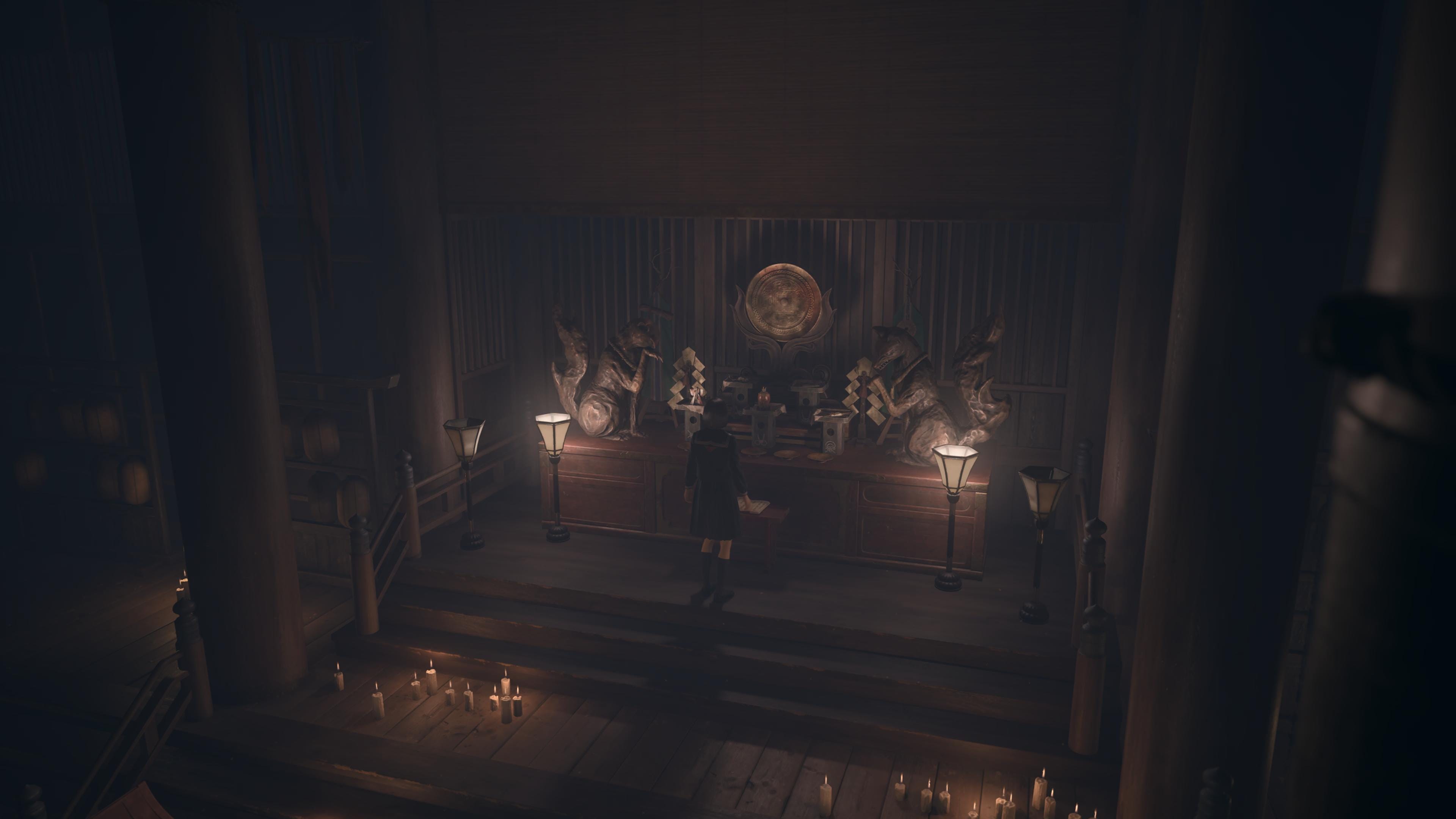
Given that half the game is set within a massive twisted version of a Shinto shrine, or jinja (神社), it’s no surprise there is a lot of religious ephemera and symbolism, including a lot of fox iconography, given this is a shrine which worships the nine-tailed fox, as well as Inari (or at least, it should… There’s plenty of elements found in Inari shrines, such as multiple ‘stacked’ red torii gates).
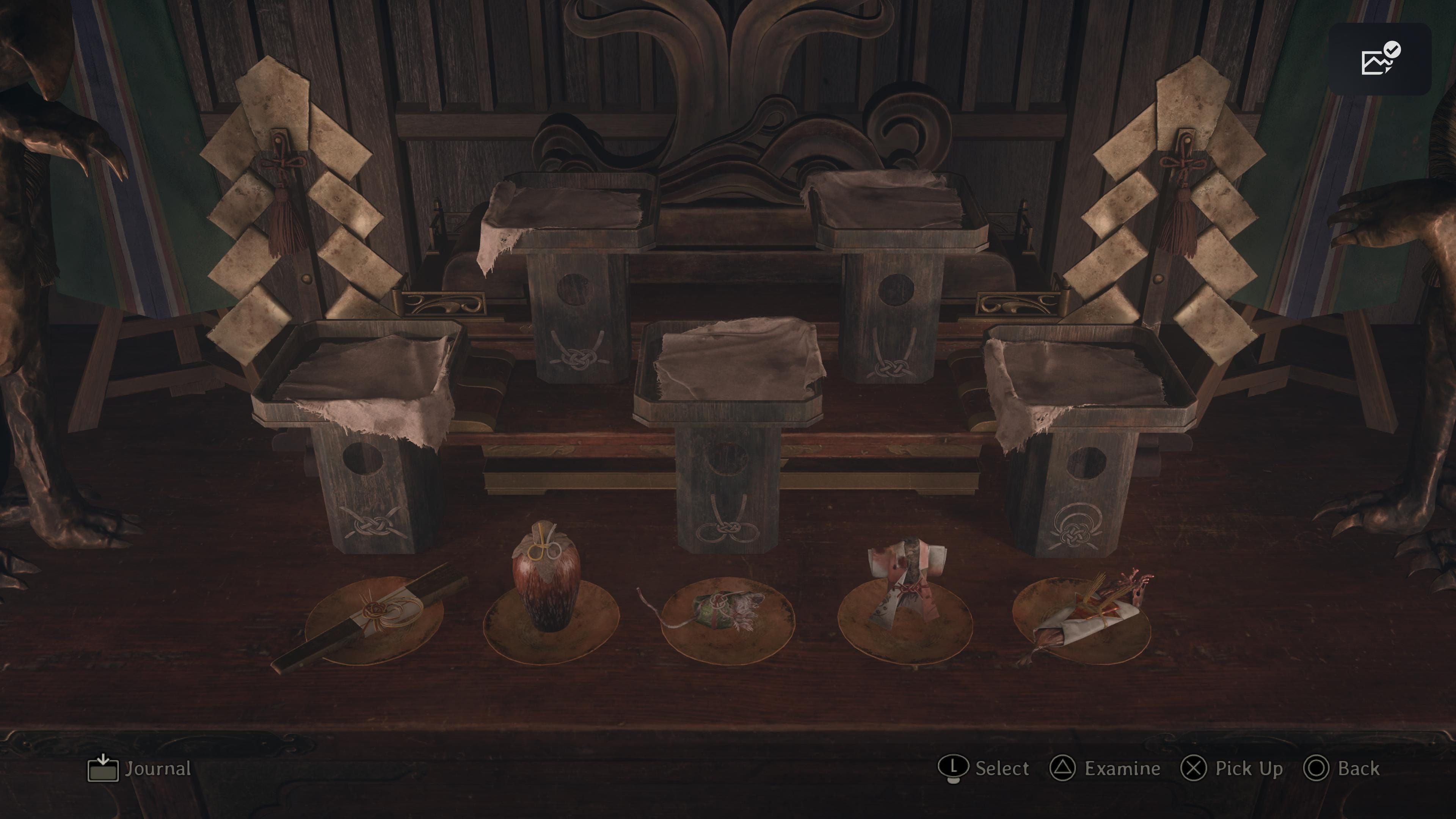
Unsurprisingly, there are a number of altars, as is the case at major shrines where a number of main deities will be enshrined, with a number of smaller ones as well. In fact one of the first shrine puzzles is set at an altar with Hinako having to use her knowledge to match each offering to its tray using the knots incoroperated with each offering (including what seems like the corpse of a rat… Nooooo.)
However while this altar does have shide paper streamers, it also has a mirror, which is a very important focal point for many Shinto shrines. The mirror is based on one of the Three Treasures, or Imperial Regalia, which traditionally comprises of a sacred sword, a gemstone or crystal and a sacrd mirror; this latter item is believed to be enshrined at Ise Grand Shrine in Mie Prefecture.
Miko (巫女) and the Shamanesses of Japan
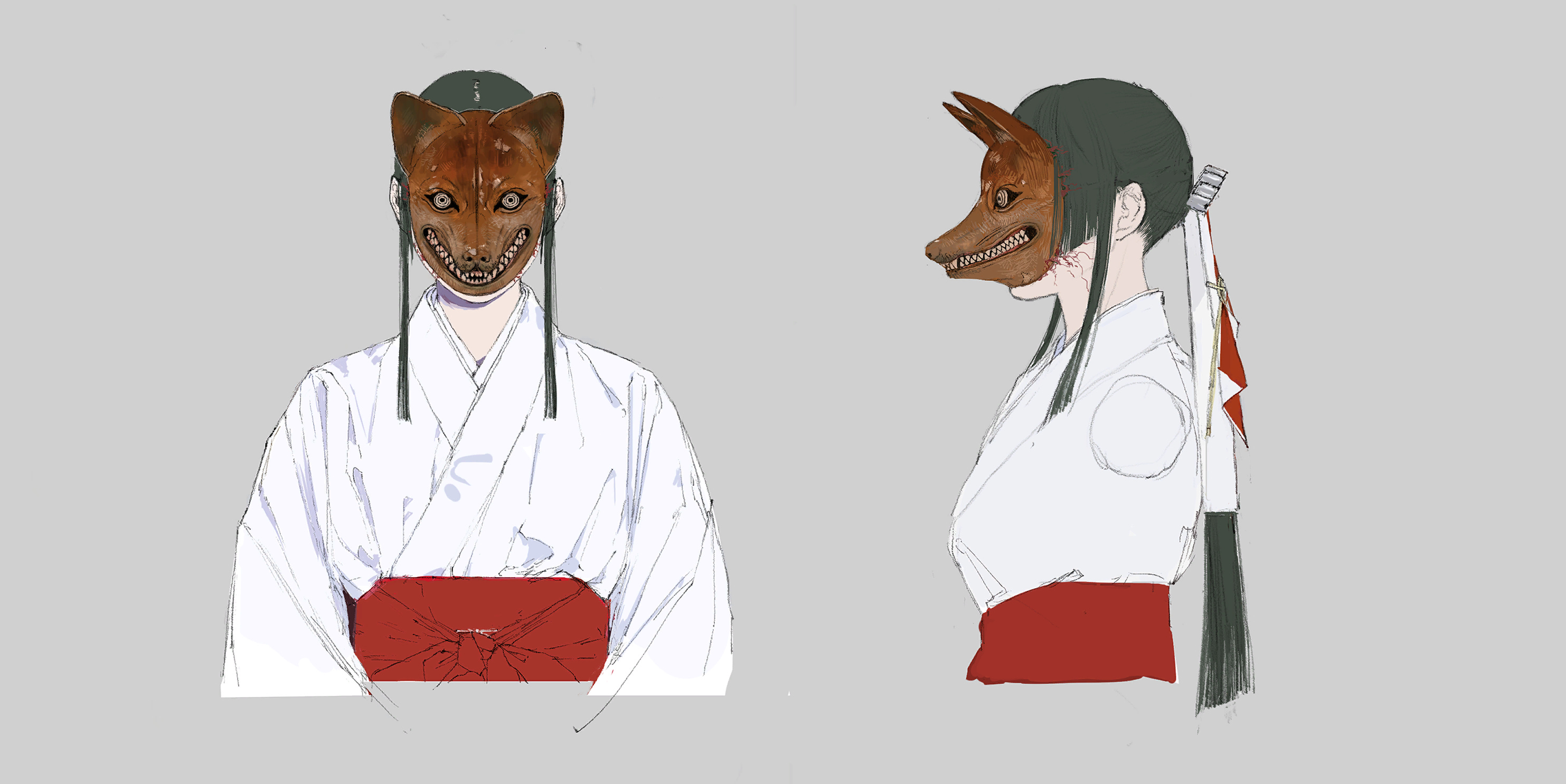
Everyone knows miko. They’re shrine maidens who are often seen with long hair and wearing white robes and red hakama trousers. They are most often seen in shrines assisting with rituals, selling omamori to visitors and writing out goshuin (dated shrine/temple seals) that are collected in special accordion-folded books called goshuinchō.
But modern miko are much more important than that. They perform rituals like kagura (神楽 ;かぐら), the sacred dance that the shadow of Sakuko can be seen performing at Sennenusugi Shrine on NG+:
Miko are also traditionally said to be innately spiritual which fits with how Sakako understands the world. Officially, she is autistic but she’s also spiritually aware and mentions dreams where she speaks with Oinari-sama, as well as the divinity identified as Tsukumogami, the spirit born from all the old items left at fox shrines around Ebisugaoka.
We also see the shrine maidens assisting with the Three Rituals deep in the Dark Shrine, they bring the ritual items like the saw and press the burning brand into Hinako’s back. They’re faceless and nameless, but integral to the ritual of the horrific events which take place there. They are only seen once, more to bring the happy couple sacred tamagushi (玉串) to be offered to the Nine-tailed Kitsune’s biggest altar.
Miko were originally shamanesses and so, in their current modern role, they continue to serve by performing dance, assisting with rituals as well as helping with the day to day running of shrines. They’re not just girls dressing up but are sacred maidens who are integral within Japanese religious life.
Orochi no Yamato and the Water Dragon Faith
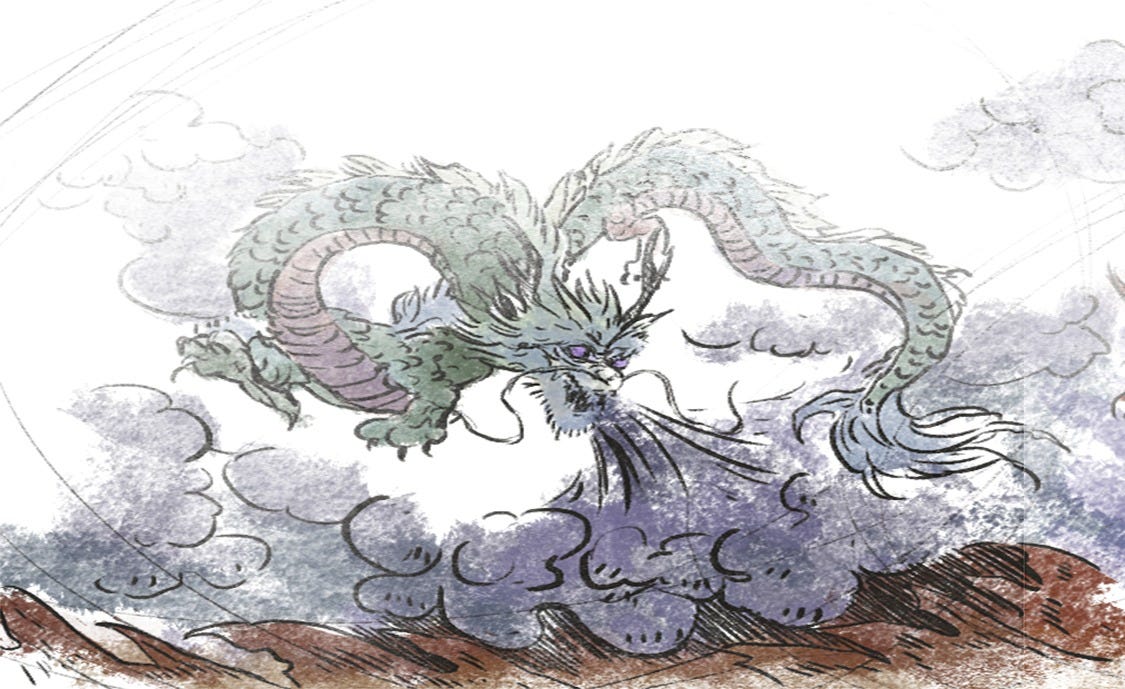
Orochi no Yamato is the Big Bad of Shinto legends, appearing in both the Kōjiki and Nihon Shōki , where he was as finally slain by the god Susanoo, brother of Amaterasu Omikami.
The mythology around this single head managing to ruin precious land in what is now Ebisugaoka is important as it becomes accepted history, whilst also giving a plausible mythological reason for the area being naturally disastrous.
Also, while dragons in the west are traditionally things of fire, the opposite is the same in Asian myth, as found in China, Japan and Korea. Dragons, like Haku in Spirited Away, are usually associated with water and rivers or seas. This makes an angry dragon head the perfect reason for geysers (basically hot water which finds its way out of the ground under pressure) as well as something which, if not controlled or mollified, threatens to destroy an entire community.
Okamisama: Amatsu (天津神) and Kunitsukami )(国津神)
A popular saying in Japan is that there are eight million kami, an almost infinite number, which suggests everything from named elementals like Inari and Tsukiyomi to the kami found in sacred rocks, trees, rivers and other minor places.
Broadly speaking, they are divided into two groups: the amatsu kami (天津神) and the kunitsu kami (国津神). As a Classicist, I always compare the former to the Greek gods of Olympus (Amatsu kami live in Takamagahara), each named with certain accepted forms, and the latter to the naiads, nymphs and other minor spirits who exist in nature but are more elemental and earthly than the Olympians or Titans.
Amaterasu Omikami
Amaterasu is the most important kami within the Shinto pantheon; the sun goddess who brings life to the world from Takamagahara. She is not the first kami though, but rather a child of the primordial couple. The Kojiki and the Nihon Shoki both call her the elder sister of Tsukiyomi and Susanoo, who was born from the left eye of Izanagi.
She is also the ancestral kami of the Imperial family, via the Emperor Jimmu who descended to Earth from Takamagahara. Even now the Imperial Family continue to workship Amaterasu at the Inner Shrine at Ise and the main worship hall is due to be pulled down and rebuilt next year.
Ojizosan
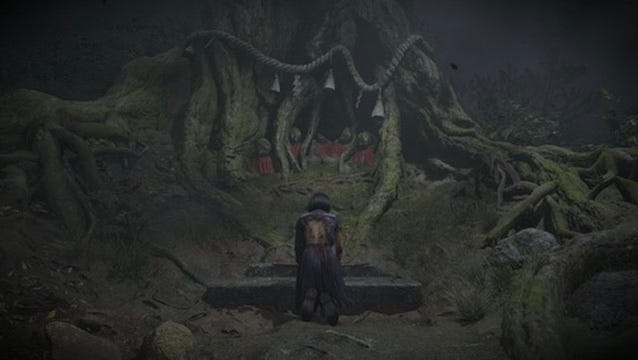
Jizo statues are something Hinako only really comes across in NG+ and they’re also more a Buddhist thing than Shinto but I’m going to mention them here regardless.
They are small, half-forgotten, statues of monks wearing red bibs and hats and, if Hinako can find all of them and offer certain items, then they will guide her to the Sacred Sword, a bonus fourth weapon which doesn’t break, although you will need to use a regular weapon every now and again in order to restore its durability.
Jizo is a beloved figure within Japanese Buddhism, a guardian of miscarried and stillborn children, as well as travellers. The statues represent a Japanese form of the bodhisattva Ksitigarbha, a Buddhist figure roughly the same as a Christian saint, who serves as a protector of the Earth and humans. Like Kannon-sama, the local form of the boddhisatva Guanyin, he has vowed to not attain Buddhahood until all souls in all the realms and hells, have been released from the cycle of samsara and suffering.
Well this was a lot! I think we’ve almost covered all the Shinto elements now but if there is enough, I’ll certainly try and continue this series as we go